Oct 12, 2026 - By Jennifer Lopez
AI Voice Agents for Real Estate: A Practical Lead-Handling Workflow

A real-estate AI voice agent handles defined phone conversations with prospective buyers, sellers, renters, or residents. Depending on how a team configures it, the agent can answer approved questions, capture intent and requirements, arrange a next step, and pass the conversation context to a human. The useful outcome is not “automation” by itself: it is a clear, timely handoff that lets the property team act with the information the caller already shared.
For an agency or developer, the best starting point is a narrow workflow—such as new buyer inquiries or viewing requests—with reliable property information, explicit boundaries, and a person responsible for exceptions.
What a real-estate AI voice agent should handle
A voice agent is software that conducts a phone conversation using speech recognition and generated speech. In a property workflow, it may identify why someone is calling, ask a small number of qualification questions, provide approved listing details, and record what should happen next.
It should not guess about availability, fees, legal terms, investment returns, or property details. If the answer is missing, uncertain, sensitive, or outside the agent’s permitted scope, it should say so and offer a human follow-up. The team remains responsible for accurate listing information and the advice it provides.
A practical inquiry-to-handoff workflow
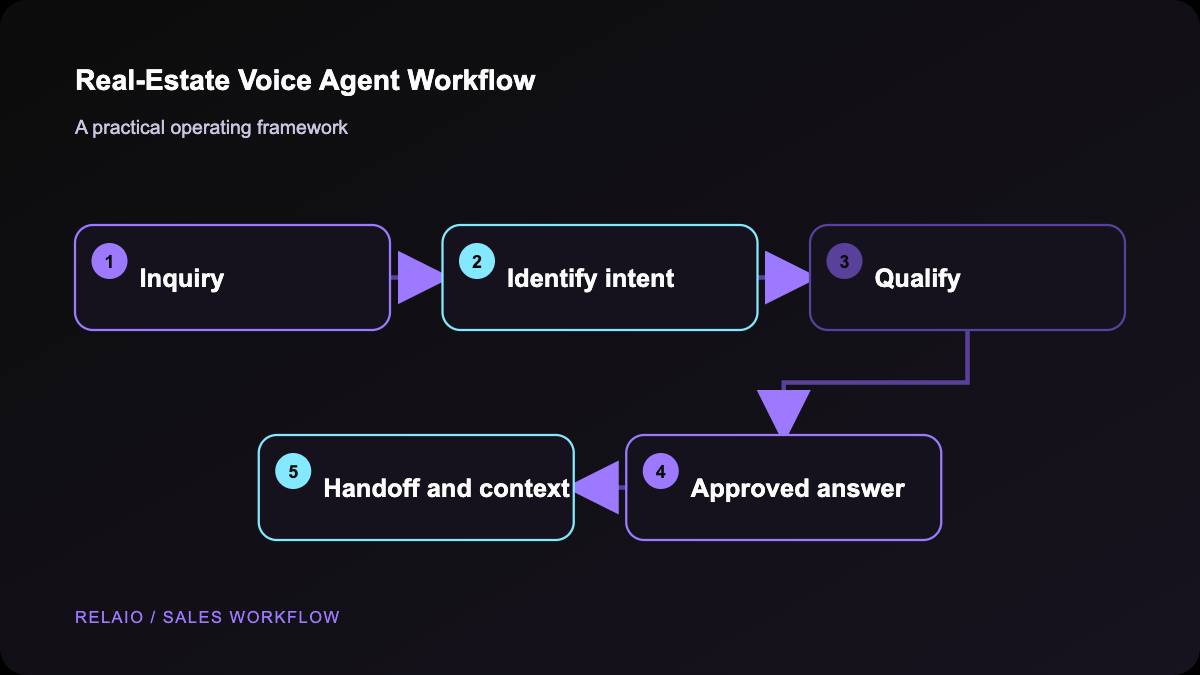
A reliable workflow has six steps:
- Capture the inquiry. Record the caller’s contact details and, when available, the property or campaign they asked about. Keep the original source so an agent can understand the context.
- Identify the intent. Establish whether the person is buying, renting, selling, asking about an existing property, or calling for another reason. Do not force every caller into a buyer funnel.
- Ask only useful qualification questions. Confirm the property type or area, budget range, timing, and preferred next step. Ask questions progressively and allow the caller to decline.
- Answer from approved information. Use current, reviewed listing details and team-approved responses. If an answer cannot be verified, avoid improvising.
- Agree on the next action. Depending on the workflow, that may be a callback request, a viewing request, a consultation, or a handoff to a named team queue. Treat a request as a request until the booking is actually confirmed.
- Pass context to a person. Send the agent a concise summary: caller intent, property of interest, stated requirements, unanswered questions, and agreed next step. Keep the original conversation available when the team’s process allows it.
This sequence gives the caller a coherent experience and gives the agent enough context to continue without asking the same questions again.
Qualification questions that help agents act
Qualification should feel like a short conversation, not an interrogation. A useful opening might be: “What are you looking for, and what would you like to do next?” Follow with only the details needed for that action.
For a buyer inquiry, a team may ask:
- Which area or property caught your attention?
- Are you looking to buy for your own use or as an investment?
- What property type and budget range should we focus on?
- When are you hoping to move or make a decision?
- Would you prefer a call from an agent or to request a viewing?
For a rental inquiry, the relevant details may include move-in timing, preferred area, property type, and viewing availability. For a seller or landlord, the questions should be different. Teams should define these branches before launch and avoid collecting sensitive information that is not needed to route the inquiry.
When to book, route, or hand off
A voice agent should follow clear rules for what it can complete and when it must involve a person. It may capture preferred viewing times or a callback window. It should confirm a booking only when the connected process actually verifies availability and creates the appointment. Otherwise, it should describe the next step accurately and send the request to the team.
Hand off when a caller asks for a person, raises a complaint, requests negotiation or advice, asks about a detail the system cannot verify, or needs an exception. The handoff should carry the reason for escalation and the information already collected. This keeps the agent useful without letting it make decisions reserved for the property team.
CRM and lead routing: preserve the conversation context
A call summary is only useful if it reaches the right place. Before deploying a voice workflow, decide which system is the source of truth for the lead, who owns each lead type, and what fields must be recorded. At minimum, the team should know the caller’s intent, property or area, qualification notes, call outcome, and next action.
Test the routing rules with common cases: an interested buyer, a rental inquiry, a wrong-number call, an unanswered transfer, and a caller who needs a human. Confirm that the owner can see the summary and that failed or incomplete updates are visible for follow-up. Do not assume that a particular portal, CRM, calendar, or property database connects natively; verify the required workflow and integration before relying on it.
Voice or WhatsApp: choose the channel by the task
Voice is useful when a conversation needs clarification, qualification, or a more natural exchange. WhatsApp can suit a short written confirmation or a follow-up the customer can revisit. Some teams use both, but the channel sequence should respect the customer’s preference and the business’s messaging permissions. A voice conversation does not automatically authorize unrelated promotional messages.
For a broader channel-by-channel response process, see the GCC real-estate lead-response workflow. For follow-up timing, see Real Estate Lead Follow-Up in 2026.
UAE and GCC operating considerations
Teams serving the UAE or wider GCC should define permitted calling purposes, consent and opt-out handling, data access, retention, and escalation rules before launch. Requirements vary by jurisdiction and by whether a call is service-related or promotional; this article is not legal advice. UAE teams can review the official telecommunications guidance and UAE data-protection guidance, then confirm their specific obligations with qualified counsel.
Language handling also needs practical testing. If the team serves Arabic- and English-speaking customers, test real estate terms, names, addresses, dialect expectations, and the point at which a human should take over. Do not claim language coverage until it has been validated for the actual workflow.
Evaluation checklist for a real-estate voice agent
Before choosing a solution, ask:
- Can the team control which listing facts and answers the agent may use?
- Can it recognize buyer, renter, seller, and service inquiries without forcing one script on everyone?
- Can staff set qualification questions, routing owners, and human handoff conditions?
- Does the call summary include the original intent and agreed next step?
- Can the team test viewing requests without representing them as confirmed bookings?
- Are language coverage, channels, integrations, data handling, and recording practices documented and verified?
- Can a manager review failures and update the workflow when inventory or team rules change?
A short pilot on one inquiry type is a better test than activating every possible workflow at once. Review call outcomes and handoff quality with the agents who will use the summaries, then expand only where the process is reliable.
Where Relaio fits
Relaio presents itself as an always-on sales platform for voice, WhatsApp, lead qualification, follow-up, and shared lead handling. Its public website also describes real-estate workflows such as qualifying buyers, requesting viewings, routing prospects, and handing context to a human. The specific channel setup, booking behavior, and integrations should be confirmed for the team’s intended workflow before launch; this guide does not assume a native connection to any property portal or CRM.
If you are evaluating a real-estate inquiry workflow, talk with Relaio about your use case and confirm which steps the current product can support.
Frequently asked questions
What does an AI voice agent do for a real-estate business?
It handles defined phone conversations, such as identifying an inquiry, asking approved qualification questions, sharing verified property information, and recording a next step. A person should take over when the caller needs advice, an exception, or an answer the system cannot verify.
Can an AI voice agent qualify property buyers?
Yes, when the team defines the questions and routing rules. Common fields include the property or area of interest, budget range, timing, and preferred next step. The agent should collect only information needed for the workflow and pass it to the responsible team member.
Can a voice agent book property viewings?
It can capture preferred times or confirm a viewing when the scheduling process verifies availability and records the appointment. If no verified calendar workflow is connected, it should pass the request to an agent instead of claiming that a viewing is booked.
Should an AI voice agent replace real-estate agents?
It is better treated as support for defined, repetitive first-contact tasks. Agents remain responsible for negotiation, advice, exceptions, relationship-building, and decisions that require professional judgment.
What should a brokerage check before using one?
Check answer controls, lead qualification, human handoff, routing, call summaries, booking behavior, language coverage, integrations, privacy, and applicable calling rules. Test the workflow with real staff before expanding it.
Turn every inquiry into a clear next step
Relaio’s public positioning connects voice, WhatsApp, follow-up, and lead handling. Discuss the specific property inquiry, qualification, routing, and handoff process your team wants to support.