Oct 15, 2026 - By Team Relaio
How Lead-Generation Agencies and Clients Should Define Lead Response SLAs

"A useful lead-response SLA between an agency and a client defines when the clock starts, which hours count, what kind of response is being measured, who owns each step and what evidence is reviewed when the process fails. It should distinguish an automated acknowledgement from a contact attempt and from a meaningful two-way sales conversation.\n\nThere is no universal response-time target that fits every business, staffing model or channel. The agency and client should choose a target they can support, define it clearly and review the exceptions together. This article is an operational planning guide, not legal contract advice or a ready-to-sign legal template.\n\n> Important: An automated acknowledgement confirms receipt only. It is not proof that a person contacted the lead or that a sales conversation happened.\n\n## Start by defining the clock\n\nWrite down the event that starts measurement. It could be a form submission, a call event, a message received or the point when a lead is successfully delivered to the client’s agreed destination. These are not interchangeable.\n\nIf the agency measures from form submission while the client measures from CRM receipt, a delivery delay can appear as a client response failure. If the system cannot verify delivery, state that limitation and record the timestamp that is available.\n\nAgree on:\n\n- which lead sources and event types are in scope;\n- what timestamp starts the clock;\n- whether the clock pauses outside agreed staffed hours;\n- how weekends, public holidays and temporary closures are handled;\n- what happens when required contact details or context are missing.\n\nDo not report a single average without defining which leads and hours it includes.\n\n## Separate receipt, acknowledgement, attempt and response\n\nUse plain definitions that both teams can audit:\n\n| Event | Operational meaning |\n|---|---|\n| Received | The lead reached the agreed intake point. |\n| Acknowledged | An automated or human message confirmed receipt. This does not show that sales contact occurred. |\n| Contact attempted | A person or approved workflow attempted an agreed contact method. Record the attempt and outcome. |\n| Meaningful response | A two-way exchange began or a substantive request was answered. Define what qualifies for your business. |\n| Disposition recorded | The current outcome and next action were documented, including unresolved or uncontactable cases. |\n\nKeeping these events separate prevents the agency from counting a delivery notification as client follow-up, or the client from treating an unanswered attempt as a completed conversation.\n\n## Assign responsibilities at each step\n\n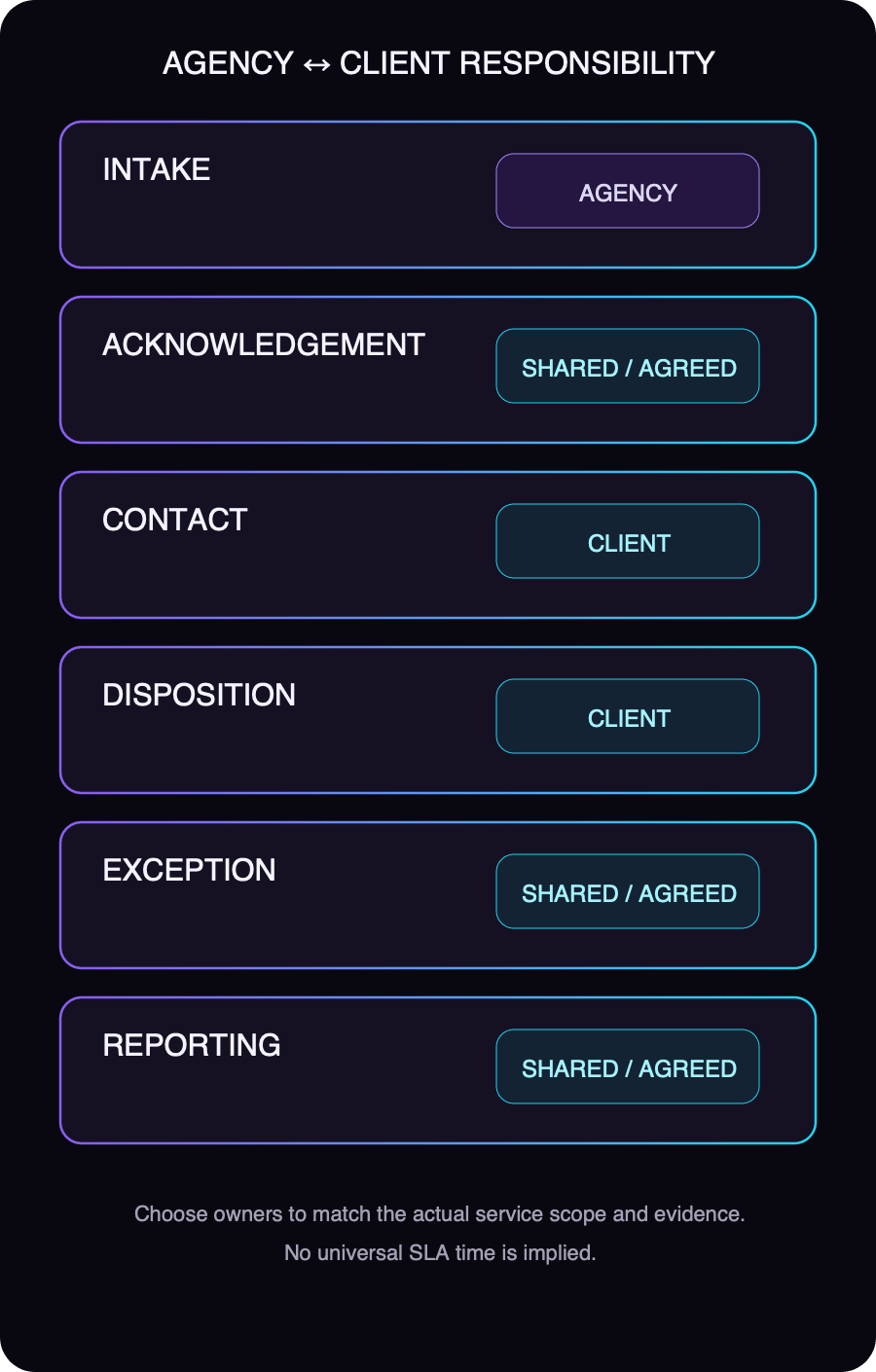 \n\n\n\nThe agreement should state who owns each activity rather than saying that “marketing” or “sales” owns the whole process.\n\nAgency responsibilities may include: ensuring the agreed capture route is operating, retaining campaign/source context, notifying the designated client destination, reporting delivery failures, and flagging missing or malformed records.\n\nClient responsibilities may include: maintaining a staffed owner or fallback, reviewing new leads, making the agreed contact attempt, recording the outcome, and returning disposition feedback under the agreed process.\n\nThese are example boundaries, not a default allocation. Some agencies provide qualification or follow-up services; others deliver leads only. State the actual scope. Do not silently transfer sales responsibility through a notification or CRM field change.\n\n## Specify what happens when the expected owner is unavailable\n\nName the fallback route for leave, meetings, high-volume periods, system access problems and after-hours arrivals. The fallback can be a duty person, monitored queue or an agreed next staffed period, but it must be explicit.\n\nIf no fallback is available, the record should remain visibly unaccepted or pending. Do not report it as “worked” merely because it was assigned. For after-hours inquiries, define whether the clock pauses, whether an acknowledgement is sent, and what expectation that message sets. See the separate after-hours lead response workflow.\n\n## Define incomplete records and failed channels\n\nAgree what minimum information is needed to begin contact. If a record arrives without a usable phone number, source, campaign context or requested service, document whether it is held, returned for correction or routed for manual review.\n\nFor channel failures, record the failure type and owner: delivery error, access issue, missing permission, unreachable contact or unknown status. Do not treat a failed delivery as proof the client ignored a lead. Do not automatically retry through a different channel unless the client’s policy and the person’s permissions support it.\n\n## Set evidence and reporting rules\n\nChoose a small set of measures that can be supported by records. Depending on the agreement, these may include:\n\n- leads received and successfully delivered;\n- timestamp of the agreed start event;\n- acknowledgement, attempt and meaningful-response timestamps separately;\n- disposition and next-action status;\n- exceptions by reason and current owner;\n- records missing required fields;\n- the time period and staffed-hour definition used.\n\nEach measure needs a source of truth and a definition. If CRM outcomes are not accessible or consistently returned, say so. Do not infer contact or qualification from ad-platform delivery or a workflow notification.\n\n## Resolve disputes through an exception review\n\nWhen agency and client disagree about a lead, review the original event, the delivery evidence, the agreed clock, contact-attempt evidence and recorded disposition. Classify the issue before assigning fault:\n\n1. Capture or delivery issue: Was the lead received and routed as agreed?\n2. Context issue: Was enough information present for the client to act?\n3. Ownership issue: Was a person or fallback actually responsible?\n4. Contact issue: Is there evidence of an attempt and its outcome?\n5. Definition issue: Did both teams interpret “response” or staffed hours the same way?\n\nRecord the decision, correction owner and review date. If the evidence is missing, mark the result unknown rather than resolving the dispute by assumption.\n\n## Response SLA review checklist\n\n- [ ] Start event and timestamp source are agreed.\n- [ ] Staffed hours, weekends and holidays are defined.\n- [ ] Receipt, acknowledgement, attempt and meaningful response are distinct.\n- [ ] Agency and client responsibilities match the contracted service scope.\n- [ ] Unavailable owners have a named fallback or explicit pending state.\n- [ ] Incomplete records and failed channels have an exception route.\n- [ ] Reporting measures have definitions, owners and evidence sources.\n- [ ] Disputes are reviewed from records, with unknowns labeled honestly.\n- [ ] Both teams review the process on an agreed cadence and update it when scope changes.\n\n## Keep the agreement operational\n\nAn SLA works when it describes observable events and people can follow it during a busy day. Review it after changes to campaigns, channels, staffing, hours or lead-delivery systems. Keep the document aligned with the real scope and actual evidence available.\n\nFor the lead’s qualification and next-action workflow, see the AI SDR workflow guide. Relaio’s Homepage describes the broader sales automation category.\n\n"